Flipkart

Tuesday, 9 February 2016

February 10

India's GDP projected to grow at 7.6% in FY16
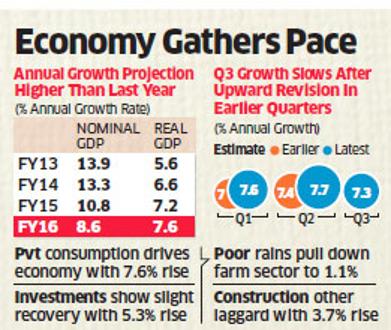
India's growth is projected to pick up pace in the current fiscal and consolidate the country's position as the world's fastest-expanding major economy despite a slight moderation in the third quarter, helping the Modi regime deflect criticism that it's not doing enough to accelerate recovery. FY16 GDP is projected to grow 7.6% compared with 7.2% last year, according to data released by the statistics office on February 8. 

The faster growth is largely because of an upward revision in first-quarter growth that showed the economy lost steam in the third quarter to 7.3%. First-quarter growth was revised to 7.6% from 7% while that for the second quarter was restated to 7.7% compared with 7.4% estimated earlier. The government had earlier said such revisions would be possible because the initial quarterly estimates had not factored in buoyant indirect tax collections. "The direction of the numbers is very positive. The policy and reform measures the government has undertaken in the past one-and-a-half years are beginning to show results," said Economic Affairs Secretary Shaktikanta Das. 

China's economy grew 6.8% in the December quarter, putting India well ahead at 7.3%. 

"The surprisingly robust pickup in manufacturing growth in Q3FY16 relative to Q2FY16 belies the trends available from various high-frequency, volume-based indicators, including the IIP (index of industrial production) prints for October-November 2015," said Aditi Nayar, senior economist, ICRA Ltd. 

Industry called for more measures to consolidate the recovery. "Going ahead, we hope to see a continued momentum on the reform front. We look forward to the Union Budget giving a positive direction to the economy," Ficci said in a statement. Finance Minister Arun Jaitley will unveil the Budget on February 29. Growth was driven by robust manufacturing, which is expected to post a 9.5% growth in GVA in the current fiscal, up from 5.5% last year. Agriculture will be a drag again, reporting only a 1.1% rise even on a 0.2% contraction last year.

The services sector is expected to perform in line with last year. On the expenditure side, the key driver was private spending with a projected expansion of 7.6% compared with 6.2% last year. Investments, as measured by gross fixed capital formation, are set to grow 5.3%, only marginally higher than 4.9% last year, capturing the problem government has faced in reviving private investment. The share of investment in GDP is down to 29.7% in FY16 from 31% in FY15. 

"This is the fifth year of fall in the investment to GDP ratio. Reviving investment is a challenge because there is excess capacity in the system. This is a challenge that the government needs to address," said DK Joshi, chief economist at Crisil. Global headwinds will also make India's task of climbing to higher growth difficult. The International Monetary Fund estimates world growth at 3.4% in 2016, down from an October forecast of 3.6% while the World Bank cut its prediction to 2.9% from 3.3% it expected last June.


Monday, 8 February 2016

February 9

Writing Off Bad Bank Loans
In response to an RTI query by The Indian Express, the Reserve Bank of India disclosed that 29 public sector banks wrote off a combined Rs 1.14 lakh crore of bad debt between 2013 and 2015.
--------------------------------------------------------------------------------------------------------------------------
Causes of increase in NPAs:

BAD AND doubtful debts of banks, called non-performing assets or NPAs in banking jargon, have been attracting wide attention for varied reasons. Some of the reasons for the burgeoning NPAs are: Bank officers do not know how to lend and are also corrupt.


The rise was due to some infrastructure projects, slowdown in global economic recovery, and continuing uncertainty in global markets leading to lower growth of credit. It was stated that public sector banks continued to be under stress on account of their past lending.


The absence of proper bankruptcy laws and the dilatory legal procedures in enforcing security rights are the root cause of bad debts in banks.


A major portion of bad debts arose out of lending to the priority sector, at the dictates of politicians and bureaucrats. If only banks had monitored their loans effectively, the bad debt problem could have been contained, if not eliminated.


The top managements of the banks were forced by politicians and bureaucrats to throw good money after bad in the case of unscrupulous borrowers. Many big borrowers defaulted only due to the recession in the economy. The absence of proper bankruptcy laws and the dilatory legal procedures in enforcing security rights are the root cause of bad debts in banks.

--------------------------------------------------------------------------------------------------------------------------
--------------------------------------------------------------------------------------------------------------------------
Why do banks write off bad debt?
Banks prefer to never have to write off bad debt since their loan portfolios are their primary assets and source of future revenue. However, toxic loans, or loans that cannot be collected or are unreasonably difficult to collect, reflect very poorly on a bank's financial statements and can divert resources from more productive activity. Banks use write-offs, which are sometimes called "charge-offs," to remove loans from their balance sheets and reduce their overall tax liability.
--------------------------------------------------------------------------------------------------------------------------

The net non-performing assets (NPAs) of state-owned banks — gross NPAs less provisions — at Rs 1.74 lakh crore at the end of September 2015 is equal to almost a third of their total net worth. In other words, if banks have to fully provide for all their bad debts, it would wipe out 33 per cent of their paid-up capital plus reserves and surplus.

In response to an RTI query by The Indian Express, the Reserve Bank of India disclosed that 29 public sector banks wrote off a combined Rs 1.14 lakh crore of bad debt between 2013 and 2015. This is more than one-third of the total gross non-performing assets of Rs 3.06 crore for public sector banks.
Looking at gross NPAs in isolation doesn’t give the full picture. Banks set aside money in the event of default or non-payment — these are called provisions. The net NPA numbers hide some unpleasant details.

One, for some banks such as Indian Overseas Bank, they make up as much as 83.3 per cent at the end of the September quarter, according to Capitaline database. For 16 out of 25 public sector banks for whom data is available, this ratio is more than 33 per cent. The average for private sector banks is 4.9 per cent. Under the fractional banking system, banks need a certain amount of capital to lend. If a large portion of its equity capital and reserves are wiped out, then a bank will not be able to lend freely, or it will have to wait for capital infusion from the government, which might not be forthcoming in times of a fiscal squeeze. Two, banks have been able to reduce their NPA numbers by not only writing off assets, but also by restructuring or refinancing them. While this might save them temporarily from being classified as bad loans, they might turn irrecoverable if investment demand doesn’t revive.


“For banks, this is just the tip of the iceberg. It is going to get much worse. Especially when some of the big companies in the power and infrastructure sector face more problems,” Hemendra Hazari, an independent analyst, said. After an asset quality review undertaken by the RBI in December, bad debts of some private sector banks rose sharply. For instance, ICICI Bank’s gross NPA jumped Rs 5,291 crore during the December quarter, the highest in nearly five years and that of Axis Bank increased by Rs 1,273 crore. Most large PSU banks are yet to report their December quarter numbers and it is only to be expected that their bad debt numbers will go up, experts said. According to rating agencies, loan write-offs are likely to rise in the coming quarters. Rajat Bahl, Director, CRISIL Ratings, said, “Loan write-offs by banks in India have shown a rising trend in the last few years. They reached a level of Rs 50,000 crore for the public sector banks in 2014-15. Another Rs 25,000 crore were written off in the first half of the current financial year, 2015-16. While the pressure on banks to write-off will continue, the extent of write-offs is unlikely to rise significantly due to two reasons — first, PSBs usually write-off to the extent of cash recoveries that they have made during a year, and the recoveries are unlikely to be buoyant due to continued stress in the corporate sector. Second, their ability to take large write-offs will also be constrained by their weak profitability.” “The quantum of provisions for loans that banks need to make, however, will continue to be high, reflecting the ongoing asset quality challenges,” Bahl said. Vibha Batra, Group Head – Financial Sector Ratings, ICRA, said, higher write-offs are on account of around 3.5 times increase in the pool of gross NPAs to over Rs 3 lakh crore, even though write-offs as per cent of opening gross NPAs have remained in the range of 20-23 per cent. Considering further likely increase in gross NPAs and large stressed accounts, write-offs in absolute amount may continue to increase over next 12-18 months. “With bad loans increasing over time, banks have been working towards lowering the same. While better credit practices and economic stability helps in controlling incremental NPAs, banks have also been writing off bad assets to strengthen their books. This in turn puts pressure on the profit and loss account, but can be considered to be necessary as a prudent practice. This will, to my mind, continue to increase until books are put in order,” said D R Dogra, Managing Director & CEO of rating agency CARE. 


Steps taken from RBI side to curb NPAs:


RBI firm on banks cleaning up balance sheet by March 2017


The RBI is not contemplating any extension of the March 2017 deadline for banks to reduce their non-performing assets (NPAs) and clean up their balance sheets, SS Mundra, Deputy Governor, RBI, said on 29 January, 2016.

Banks have already started the process in the quarter ended December 2015. “It will be painful in the short term but will benefit them in the long run,” he added.
When asked about the delay in selling assets of corporate defaulters seized under the Securitisation and Reconstruction of Financial Assets and Enforcement of Security Interest (Sarfaesi ) Act, 2002 by banks, he said the present legal system allows big defaulters to delay the process while, at the same time, is harsh on petty defaulters. The new bankruptcy law, now on the anvil, will correct this anomaly, he added.
He said corporate sector leverage has currently become an issue of great concern for the economy in general and the banking system in particular.
“As we notice now, several indiscriminate corporate houses continued market borrowing with a view to increase their market share and to expand capacity without any regard to domestic and global demand situation,” he said. In fact, the rate of sales growth of the corporate sector, particularly of listed manufacturing companies, declined from an average of 28.8 per cent in Q1 of 2010-11 to 11.4 per cent in Q2 of 2012-13 at a time when inflation averaged around 10 per cent. Some of these borrowers necessarily fall into the category of Ponzi borrowers, the Deputy Governor pointed out.
--------------------------------------------------------------------------------------------------------------------------
Ponzi scheme:  A Ponzi scheme is a fraudulent investment operation where the operator, an individual or organization, pays returns to its investors from new capital paid to the operators by new investors, rather than from profit earned by the operator. Operators of Ponzi schemes usually entice new investors by offering higher returns than other investments, in the form of short-term returns that are either abnormally high or unusually consistent.

Ponzi schemes occasionally begin as legitimate businesses, until the business fails to achieve the returns expected. The business becomes a Ponzi scheme if it then continues under fraudulent terms. Whatever the initial situation, the perpetuation of the high returns requires an ever-increasing flow of money from new investors to sustain the scheme.

--------------------------------------------------------------------------------------------------------------------------

Stating that the return on assets in public sector banks was “weak”, he said new areas of untapped potential, such as financial inclusion, should be identified, and banks should innovate in technology and products.


Banks should focus on bread and butter issues in business and more research should be taken up. He identified agricultural credit, micro, small and medium enterprise (MSME) advances and risk mitigation, among others, as important areas for research.


Steps taken from Government to curb NPAs:


Insolvency and Bankruptcy Code: A legislation to promote investments, develop credit markets


The government on Decemnber 21, 2015 introduced in Parliament the ‘Insolvency and Bankruptcy Code, 2015’ that provides for resolution of insolvency in a speedier and time-bound manner.

The bill aims at promoting investments, freeing up banks’ resources for other productive uses, boosting credit markets and improving ease of doing business in India.
An effective legal framework for timely resolution of insolvency and bankruptcy would support development of credit markets and encourage entrepreneurship, according to the statement of objects and reasons of the bill tabled in Lok Sabha by Finance Minister Arun Jaitley.
The bill also provides for setting up of an ‘Insolvency and Bankruptcy Board of India’ to regulate professionals, agencies and information utilities engaged in resolution of insolvencies of companies, partnership firms and individuals.
“The Code also proposes to establish a fund to be called the Insolvency and Bankruptcy Fund of India…,” as per the document tabled.
It further says that a new legislation is needed to deal with insolvency and bankruptcy as the existing framework is “inadequate, ineffective and results in undue delays in resolution”.
As per the proposed legislation, the corporate insolvency would have to be resolved within a period 180 days, extendable by 90 days. It also provides for fast-track resolution of corporate insolvency within 90 days.
“The government’s move to table the Bankruptcy Law is a welcome step, given the relatively long duration of insolvency proceedings in India vis-à-vis other OECD (Organisation for Economic Co-operation and Development) countries,” said K.V. Karthik, partner, Financial Advisory Services, Deloitte Touche Tohmatsu India LLP.
Currently, there is no single law dealing with insolvency and bankruptcy in India. Liquidation of companies is handled by the high courts, individual cases are dealt with under the Presidency Towns Insolvency Act, 1909 and Provincial Insolvency Act, 1920.
Other laws which deal with the issue include SICA (Sick Industrial Companies Act), 1985; Recovery of Debt Due to Banks and Financial Institutions Act, 1993, Sarfaesi (Securitisation and Reconsutriction of Financial Asseets and Enforcement of Security Interest) Act, 2002 and Companies Act, 2013.
As a result, four different agencies, the high courts, the Company Law Board, the Board for Industrial and Financial Reconstruction (BIFR), and the Debt Recovery Tribunals (DRTs), have overlapping jurisdiction, giving rise to the potential of systemic delays and complexities in the process. A strong bankruptcy law can help overcome these challenges.
The Code also seeks to balance the interest of all the stakeholders including alteration in the priority of payment of government dues.
N K Premchandran of RSP opposed the bill, saying it was a defective piece of legislation, but later the lower House through voice allowed its introduction.
The Code seeks to provide for designating National Company Law Tribunal (NCLT) and Debt Recovery Tribunal (DRT) as the adjudicating authorities for corporate persons and firms and individuals, respectively, for resolution of insolvency, liquidation and bankruptcy.
Till the Insolvency and Bankruptcy Board of India is set up, the central government will exercise the powers of the Board or designate any financial sector regulator the powers and functions.
The bill also provides for priority with regard to distribution of proceeds following liquidation of the company. In the order of priority, the first charge will be insolvency resolution process cost and liquidiation costs to be paid in full.
Liquidation proceeds will then be used to clear debts owed to secured creditors, and then to pay workmen’s dues for 12 months, unpaid dues to employees other than workmen, and financial dues owed to unsecured creditors, in that order. Government taxes for two years, other debts, preference shareholders and equity shareholders will receive last priority for payment.
It also provides for monetary penalty and jail term of up to five years for concealment of property, defrauding creditors and furnishing false information.
The Code also provides for fast track corporate insolvency resolution process to be completed in 90 days.
“Having a robust insolvency resolution mechanism can help creditors recover a larger part of their investment faster, allowing them to re-invest in other businesses, thereby facilitating the efficient flow of capital across the economy,” Karthik said.
Comparison with the US Chapter 11
In the US, there are two main bankruptcy procedures for corporations, Chapter 7 and Chapter 11.
Chapter 7 is the liquidation code and provides for the appointment of a trustee by the court to oversee the liquidation of the company. Under Chapter 7, the business is closed down before sale and the assets auctioned.
Chapter 11 allows a firm to remain in operation while a plan of reorganisation is worked out with creditors.
The Indian Code provides for quick identification of financial distress and a 180-day plan, extendable by 90 days, to revive a company, following which the company becomes insolvent.
With regard to management control, under the US Chapter 11, the company retains the management control while working to achieve pre-agreed goals within a certain timeframe.
The Indian code provides for management control to pass over to resolution professionals with significant powers, once an insolvency resolution is underway.


Public sector lenders write off more 
bad loans than recovery


Smart Villages - Shyama Prasad Mukherji Rurban 

Mission(SPMRM)
Union Cabinet approves Shyama Prasad Mukherji Rurban Mission to drive economic, social and infrastructure development in rural areas on 16 September, 2015.
--------------------------------------------------------------------------------------------------------------------------
Shyama Prasad Mukherji - Shyama Prasad Mukherji (6 July 1901 – 23 June 1953) was an Indian politician, barrister and academician, who served as Minister for Industry and Supply in Prime Minister Jawaharlal Nehru's cabinet. After falling out with Nehru, Mukherjee quit the Indian National Congress and founded the right wing nationalist Bharatiya Jana Sangh (which would later evolve into BJP) in 1951.
--------------------------------------------------------------------------------------------------------------------------
In an ambitious bid to transform rural areas to economically, socially and physically sustainable spaces, the Union Cabinet chaired by Prime Minister Shri Narendra Modi on 16 September, 2015 approved the Shyama Prasad Mukherji Rurban Mission (SPMRM) with an outlay of Rs. 5142.08 crores.

The Mission aims at development of rural growth clusters which have latent potential for growth, in all States and UTs, which would trigger overall development in the region. These clusters would be developed by provisioning of economic activities, developing skills & local entrepreneurship and providing infrastructure amenities. The Rurban Mission will thus develop a cluster of Smart Villages.

These clusters would be well delineated areas with planned layouts prepared following the planning norms (as laid down in the State Town and Country Planning Acts/similar Central or State statutes as may be applicable), which would be duly notified by the State/UTs. These plans would be finally integrated with the District Plans/Master Plans as the case may be.

The State Governments would identify the clusters in accordance with the Framework for Implementation prepared by the Ministry of Rural Development. The clusters will be geographically contiguous Gram Panchayats with a population of about 25000 to 50000 in plain and coastal areas and a population of 5000 to 15000 in desert, hilly or tribal areas. There would be a separate approach for selection of clusters in Tribal and Non-Tribal Districts. As far as practicable, clusters of village would follow administrative convergence units of Gram Panchayats.

For the selection of clusters, the Ministry of Rural Development is adopting a scientific process of cluster selection which involves an objective analysis at the District, Sub District and Village level, of the demography, economy, tourism and pilgrimage significance and transportation corridor impact. While the Ministry, following this analysis, would provide a suggestive list of sub districts to the State, the State Governments would then select the clusters following a set of indicated principles included in the Framework for Implementation.

The mission aims to create 300 such Rurban growth clusters over the next 3 years, across the country. The funding for Rurban Clusters will be through various schemes of the Government converged into the cluster. The SPMRM will provide an additional funding support of upto 30 percent of the project cost per cluster as Critical Gap Funding (CGF) as Central Share to enable development of such Rurban clusters.

To ensure an optimum level of development, fourteen  components have been suggested as desirable for the cluster, which would include;  Skill development training linked to economic activities, Agro Processing/Agri Services/Storage and Warehousing, Digital Literacy, Sanitation, Provision of piped water supply, Solid and liquid waste management, Village streets and drains, Street lights, Fully equipped mobile health unit, Upgrading school /higher education facilities, Inter-village road connectivity, Citizen Service Centres- for electronic delivery of citizen centric services/e-gram connectivity, Public transport., LPG gas connections.

The States would prepare Integrated Cluster Action Plans for Rurban Clusters, which would be comprehensive plan documents detailing out the strategy for the cluster, desired outcomes  for the cluster under the mission, along with the resources to be converged under various Central Sector, Centrally Sponsored and State Sector schemes, and the Critical Gap Funding (CGF) required for the cluster. 

In addition to the Critical Gap Funding, proactive steps have been taken to ensure the success of the mission with adequate budget provisions for supporting the State Government towards project development, capacity building and other institutional arrangements at the state level.

The Mission envisages institutional arrangements both at the State and Center to ensure smooth implementation of the Mission. The Mission also has an Innovation budget towards facilitating research, development and capacity building.


The scheme through development of rurban growth clusters aimed at catalyzing overall regional growth,  would thus simultaneously benefit the rural as well as urban areas of the country, by achieving twin objectives of strengthening rural areas and de burdening the urban areas hence leading to balanced regional development and growth of the country.
--------------------------------------------------------------------------------------------------------------------------
A step towards substitution of SPMRM scheme for PURA and Bharat Nirman Programmes : 
In 2004, the Atal Bihari Vajpayee's NDA government launched a scheme named Provision of Urban Amenities to Rural Areas (PURA) to modernise villages by providing urban infrastructure and services in rural hubs to create economic opportunities outside of cities. PURA envisaged physical connectivity by providing roads, electronic connectivity by providing communication network and knowledge connectivity by establishing professional and technical institutions. The UPA government took it forward under the broader Bharat Nirman programme.
Union Rural Development Minister Birender Singh said the clusters would be developed by stimulating economic activities, developing skills and infrastructure amenities, as well as supporting local entrepreneurship.
He said earlier programmes such as Provision of Urban Amenities in Rural Areas (PURA) failed because of lack of government involvement. Claiming that SPMRM will be different, he said programmes like PURA were run by private agencies and NGOs. “A need was felt to initiate the scheme in a new format,” he added.
--------------------------------------------------------------------------------------------------------------------------
Shyama Prasad Mukherji Rurban Mission

Neeranchal National watershed Project
World Bank Assisted Project "Neeranchal" for the Watershed Component (Erstwhile Integrated Watershed Management Programme) of the Pradhan Mantri Krishi Sinchayi Yojana 

The Cabinet Committee on Economic Affairs (CCEA), chaired by the Prime Minister Shri Narendra Modi, on October 7,2015 has given its approval to:

 (i) implement the World Bank assisted National Watershed Management Project "Neeranchal" with a total outlay of $357 million (Rs 2142.30 crore at Rs. 60 = $1)
(ii) implement the project at the National level as well as in the nine States of Andhra Pradesh, Chattisgarh, Gujarat, Jharkhand, Madhya Pradesh, Maharashtra, Odisha, Rajasthan and Telangana.

The total cost of the project is Rs. 2142.30 crore of which the Government's share is Rs. 1071.15 crore (50 percent) and rest is the loan component from the World Bank.

For achieving the major objectives of the Watershed Component of the Pradhan Mantri Krishi Sinchayi Yojana (PMKSY) and for ensuring access to irrigation to every farm (Har Khet Ko Pani) and efficient use of water (Per Drop More Crop), Neeranchal is primarily designed to address the following concerns:

i. bring about institutional changes in watershed and rainfed agricultural management practices in India,
ii. build systems that ensure watershed programmes and rainfed irrigation management practices are better focused, and more coordinated, and have quantifiable results,
iii. devise   strategies   for   the   sustainability   of   improved   watershed management practices in programme areas, even after the withdrawal of project support,
iv. through   the  watershed   plus   approach,   support   improved   equity, livelihoods, and incomes through forward linkages, on a platform of inclusiveness and local participation.

Neeranchal will translate into better implementation outcomes of PMKSY. The programme will lead to reducing surface runoff of rainwater, increasing recharge of ground water and better availability of water in rainfed areas resulting in incremental rainfed agriculture productivity, enhanced milk yield and increased cropping intensity through better convergence related programmes in project areas.

Neeranchal is designed to further strengthen and provide technical assistance to the Watershed Component of PMKSY, in particular and all  components of PMKSY, in general, to enhance its delivery capacity.  Neeranchal will support the Watershed component of PMKSY (erstwhile IWMP) which was implemented by the Department of Land Resources (DoLR) in 28 States.

Watershed development projects are area development programme and all  people living in the project area will be benefitted.

Background:

The Integrated Watershed Management Programme (IWMP) was implemented since 2009-10 by the DoLR, for supporting watershed development in 28 States. From 2015-16 onwards, the IWMP will be implemented as the Watershed Component of PMKSY.

The potential of the watershed approach followed by the erstwhile IWMP to support both conservation and production outcomes including the availability of water in rainfed areas, catering to the needs of small and marginal farmers as well as the asset-less, including women, has been successfully demonstrated at scale across various States of India. However, despite these successes, a number of challenges remain for watershed development to achieve better outcomes, including enhanced participation of communities, building stronger capacities and systems to plan, implement, monitor and post-project sustainability of local institutions and assets. These challenges, if not resolved, can result in implementation delays, slow disbursements and benefits.

--------------------------------------------------------------------------------------------------------------------------
Pradhan Mantri Krishi Sinchai Yojana:
Pradhan Mantri Krishi Sinchai Yojana 

Krishi Sinchayee Yojana with an outlay of Rs.50,000 crores for a period of 5 years (2015-16 to 2019-20) to achieve convergence of investments in irrigation at the field level. 

Pradhan Mantri Krishi Sinchayee Yojana (PMKSY) has been formulated amalgamating ongoing schemes viz. Accelerated Irrigation Benefit Programme (AIBP) of Ministry of Water Resources, River Development & Ganga Rejuvenation; Integrated Watershed Management Programme (IWMP) of Department of Land Resources; and On Farm Water Management (OFWM) component of National Mission on Sustainable Agriculture (NMSA) of Department of Agriculture and Cooperation. PMKSY is to be implemented in an area development approach, adopting decentralized state level planning and projectised execution, allowing the states to draw their irrigation development plans based on district/blocks plans with a horizon of 5 to 7 years. States can take up projects based on the District/State Irrigation Plan. 

All the States and Union Territories including North Eastern States are covered under the programme. 

The National Steering Committee (NSC) of PMKSY under the chairmanship of Hon’ble Prime Minister, will provide policy direction to programme framework and a National Executive Committee (NEC) under the chairmanship of Vice Chairman of NITI Aayog will oversee the programme implementation at national level. 

Provision has been made under PMKSY during 2015-16 for carrying out extension activities in the field with special focus on water harvesting, water management and crop alignment for farmers and grass root level field functionaries. 

This information was given by the Minister of State for Agriculture Sh. Mohanbhai Kalyanjibhai Kundaria in Lok Sabha on 4 August, 2015. 
--------------------------------------------------------------------------------------------------------------------------

February 8

The Negotiable Instruments (Amendment) Second Ordinance, 2015

  • Ordinance aimed at speedy disposal of cases.
  • When cheque were issued as a negotiable instrument, there was always a possibility that the same being issued without a proper balance in the account of drawer(or payer). In a view to protect the drawee(or payee) of the cheque, a need was felt that dishonouring the cheque should be made a punishable offence.
  • Pending cases to be tried in the first court.
  • Court cases to remain at the same court.
  • Dishonour Cheques - 2 Years punishment.
The amendment, which enables filing of cheque bounce cases in the place where the cheque was presented for clearance or payment and not the place of issue, seeks to overturn a Supreme Court ruling which said the cases have to be initiated where the issuing branch was located.
An estimated 18 lakh cheque bounce cases are there across the country, of which about 38,000 are pending in High Courts. The amendment provides that cases of bouncing of cheques can be filed only in a court in whose jurisdiction the bank branch of the payee (person who receives the cheque) lies.
If a complaint against a person issuing a cheque has been filed in the court with the appropriate jurisdiction, then all subsequent complaints against that person will be filed in the same court, irrespective of the relevant jurisdiction area.


The Negotiable Instruments (Amendment) Second Ordinance, 2015
  • The Negotiable Instruments (Amendment) Second Ordinance, 2015 was promulgated on September 22, 2015.  The Ordinance amends the Negotiable Instruments Act, 1881.  The Act defines promissory notes, cheques and specifies penalties for bouncing of cheques, and other violations.  It does not however specify the jurisdiction of courts where cheque bouncing cases may be filed. 
  • The Ordinance will be deemed to have been in force from June 15, 2015.  It modifies the definition of a cheque in electronic form, and clarifies the appropriate area of jurisdiction of courts, where cases of cheque bouncing can be filed.  Key features of the Ordinance include:
  • In the case of a cheque being dishonoured:
  • If the cheque is delivered for collection to the account of the payee (person who receives the cheque), the jurisdiction of courts lies over the area of the bank branch where the payee maintains an account, or
  • If the payee presents a cheque to a bank in any other way, the jurisdiction lies in the area of the bank branch where the drawer (person who writes the cheque) maintains an account. 
  • All cases of cheque bouncing which were pending in any court, before the Ordinance came into force, will be transferred to a court with the appropriate jurisdiction.
  • If the payee has filed a complaint against the drawer in a court with the appropriate jurisdiction, all subsequent complaints against that person regarding cheque bouncing will be filed in the same court.  This will be irrespective of the mode of presentation of cheque.
  • If more than one case is filed by the same payee against the same drawer before different courts, the case will be transferred to the court with the appropriate jurisdiction before which the first case was filed.
  • The Ordinance also amends the definition of ‘cheque in the electronic form’.  Under the Act, this was defined as a cheque containing the exact mirror image of a paper cheque and generated in a secure system using a digital signature.  The definition has been amended to mean a cheque drawn in electronic medium using any computer resource, which is signed in a secure system with a digital signature and asymmetric crypto system (pair of a public key and private key to create a digital signature), or electronic system. 
  • The definitions of ‘computer resource’, ‘digital signature’, ‘electronic system’ and ‘asymmetric crypto system’ are amended to be the same as those assigned to them in the Information Technology Act, 2000.

Monday, 1 February 2016

February 2

Focussed Implementation of Well Knitted Interlinked Initiatives Will Ensure ‘Sabka Saath;Sabka Vikas’-Dr.Najma Heptulla

‘Nai Manzil’ to Enabe Minority Youth to Seek Better Employment-Dr.Najma Heptulla 


Dr Najma Heptulla, the Union Minister for Minority Affairs said that the government is committed and focused on "Sabka Saath ; Sabka Vikas" through implementation of well knitted interlinked initiatives. Dr. Najma said going by the Nation priority, her ministry has taken many new initiatives to strengthen the efforts towards economic empowerment of minority through Skill Development and education.


Elaborating on new initiatives undertaken during last 20 months, Dr. Najma Heptullah informed that her Ministry formulated and launched a new scheme 'Nai Manzil' on 8th  August, 2015. The scheme will benefit the minority youths who do not have formal school leaving certificate, i.e., those in the category of school-dropouts or educated in the community education institutions like Madarsas, with a view to enabling them to seek better employment in the organised sector and thus to equip them for better lives. Scheme has been approved with the cost of Rs. 650 crore for the five years. The world Bank has approved the funding of US$ 50 million and recommended the scheme to countries in Africa faced with similar development challenges.


The Ministry explained that skills and crafts practiced by minority communities no more remain lucrative and became unattractive rendering these craftsmen to look for some other means of livelihood. She said to make these skills and crafts more profitable and another new ambitious initiative of the Government, "USTTAD (Upgrading the Skills and Training in Traditional Arts/Crafts for Development)" was formally launched on 14th May, 2015 at Varanasi (U.P.). The scheme aims at capacity building and updating the traditional skills of master craftsmen and artisans. The scheme will also set standards for traditional skills. The trained master craftsmen/artisans will train the minority youth in various specific traditional arts/crafts.

To further support the initiative, artisans and craftsmen, Ministry has signed a MoU with an E-commerce portal shopclues.com for facilitating the market linkages of crafts, she added.

Ministry of Minority Affairs was created on 29th January 2006 for formulation of policies for welfare and socio-economic development of 6 (six) notified minority communities namely, Muslims, Christians, Sikhs, Buddhists, Parsis and Jains, which constitute more than 19% of India’s population.


The other initiatives of the Ministry of Minority Affairs ,she briefed  and replied included  establishment of Maulana Azad National Academy for Skills (MANAS), a special purpose vehicle, to address all skill development needs of minority communities, award of about 86 lakh Scholarships During 2014-15,  

 “Padho Pardesh”,  for providing interest subsidy on educational loans taken from Banks by minority students for higher studies abroad, unique initiative of “Hamari Dharohar” aimed at preservation of rich heritage and culture of minorities, by supporting curation of iconic exhibitions, calligraphy, preservation of old documents, research and development, restructured Multi-sectoral Development Programme or Jan Vikaas Karyakram, for area development programme ,  “Nai Roshni” for Leadership Development of Minority Women by providing knowledge, tools and techniques for interacting with Government systems, banks and intermediaries at all levels, concessional loans by National Minorities Development & Finance Corporation(NMDFC) for self-employment,activities and initiatives  of  the National Waqf Development Corporation (NAWADCO).

What is National Waqf Development Corporation ?
Waqf means a permanent dedication of a person professing Islam of any movable or immovable property for any purpose recognized by Muslim law as - auspicious, religious or charitable

Wakif is a person donating property. Once the property is donated the donor loses all the rights over the property and such property cannot be transferred, mortgaged, or alienated without permission of the Waqf board.
In 2007 there were reports from Kerala indicating many irregularities in transferring of Waqf land or properties to private parties. This resulted into huge loss to Indian exchequer amounting to 2 lakh crore rupees. To look into the issue government of India formed Sachar Committee.
Sachar Committee Recommendations:
  • India has largest number of Waqf properties around 4.9 lakhs with approximate income from these properties to 163 crore rupees.
  • If these properties are managed and developed properly could fetch around an income of 12000 crore rupees per annum.
  • A national level institution should be developed to take care of Waqf properties for community welfare particularly of Muslim community.
National Waqf Development Corporation Limited is an Indian government agency under Ministry of Minority Affairs . This will undertake development of Waqf properties for the community welfare particularly for Muslims in India. The prime minister Man Mohan Singh unveiled it on 28 January 2014. It has been established as a follow up of the recommendations of Sachar committee report.It work in a joint venture with the States and UT's waqf boards and the Mutawallis. It will have the status of Central Public Sector Enterprises.

What is National Minorirties Development and Finance Corporation?
National Minorities Development and Finance Corporation (NMDFC) was incorporated in September 1994 as a non profit company under Ministry of Social Justice and Empowerment, Government of India to provide concessional finance for self-employment activities to eligible beneficiaries belonging to the minority communities, having a family income below double the poverty line.


After the establishment of the Ministry of Minority Affairs, the administrative control of NMDFC directed into this ministry

Sunday, 31 January 2016

Takeaways from the visit of French President François Hollande to India

Francois Hollande was the chief guest on 67th Republic Day celebration. This was the fifth time that a French leader has been a Chief Guest at India's Republic Day celebrations - the maximum number from any country so far.

Importantly, France was the first country with which India established a Strategic Partnership in 1998 after New Delhi did nuclear tests. The two countries have close cooperation in defence, space, civil-nuclear and security issues along with strong trade and investment and cultural ties. France is also the first country with which India entered into civil nuclear energy cooperation in 2008 after obtaining the NSG waiver.

France, being a permanent member of UNSC can help India to get a permanent seat in UNSC.
  • The permanent members of the United Nations Security Council, also known as the Permanent Five, Big Five, or P5, include the following five governments: China(1971), France(1958), Russia(1992), the United Kingdom(1945), and the United States(1945).
India and France on 25 January, 2016 signed a Memorandum of Understanding over the purchase of 36 Rafale jets(manufactured by France Aircraft Company - Dassault). The deal, announced in April,2015 by Prime Minsiter Narendra Modi, has been in limbo after negotiations hit a roadblock over price issues. The purchase of the 36 Rafale jets from France would cost India around Rs 60,000 crore.

France and India Solar Pact
  • French Development Agency will contribute 300 million euros for the development of solar energy over the next five years in order to finance the initial projects to be undertaken by the International Solar Alliance (ISA) and the real challenge was to attract investments worth a trillion dollars to promote the renewable source., French President Francois Hollande said on 25 January, 2016.
  • Speaking at an event in Gurgaon to lay the foundation stone for ISA headquarters and secretariat, Hollande said the India-led initiative will require an investment of about 1,200 billion euros to achieve the target of installing 100 GW solar energy by 2022, and it has the full support of France.
  • He said,"Your country is the precursor, your country is the promoter, your country is the investor as you have decided to generate 40% of your electricity from renewable energy by 2030".
  • The International Solar Alliance, envisaged to bring together 122 countries that lie wholly or partly between the Tropic of Cancer and the Tropic of Capricorn, is an initiative announced by Mr. Modi at the COP 21 Summit in Paris in November. The member countries are to be those that enjoy 300 or more days in a year of bright sunlight.
India and France deal during Modi visit of France in April, 2015
  • Areva and Nuclear Power Corporation of India Ltd (NPCIL) had taken the first concrete steps in April, 2015 towards making the Jaitapur nuclear power plants a reality with both companies signing an early works agreement. This will be the first formal pact between the two sides for Areva to begin work on the planned six EPR (evolutionary power reactor) power plants.
  • Infrastructure being close to Modi's heart, discussions through his first day in France focused on "Clean Ganga", railways, waste management and smart cities. France has been designated a partner country for development of smart cities.

Tuesday, 1 December 2015

December 1

Recently India launched an International Solar Alliance (ISA) at the CoP21 Climate Conference in Paris. Examine the  significance and objectives this Alliance. (200 Words)International Solar Alliance was launched by Prime Minister Narendra Modi at CoP21 in Paris. The new body has invited all countries located partly or fully between the tropics of Cancer and tropics of Capricon to join. ISA is to function from the National Institute of Solar Energy in India, Gurgaon.
Significance of ISA
India set the target for Intended Nationally Determined Contributions to reduce greenhouse gas emission by 33-35 percent by 2030 below its 2005 level. To achieve this, the government has launched Jawaharlal Nehru National Solar Mission for the generation of 20 GW solar power by 2022. India is the third highest greenhouse gas emitter after China(29 percent of global GHG emission) and US(15 percent of global GHG emission). ISA will help India to meet its commitment of 40 percent of non-fossil fuel energy to be adopted by 2030.
Objectives of ISA
The objective of ISA is to reduce the cost of finance and technology that is needed to deploy solar power widely. However, generation and storage technology would be adapted to the individual countries' need. The task that alliance will pursue are, cooperation in training, building institutions, regulatory issues, common standards, and investment including joint ventures. India can also get upper hand over the WTO dispute with US solar panel industries, because with ISA India will have cheaper technology available with her.

Wednesday, 25 November 2015

UPSC CAPF Interview

BSF to enter its 50th year in 1 December, 2014
Border Security Force (BSF) will enter its 50th year of distinguished service to the nation and commence its ‘Golden Jubilee Celebrations’ on December 1, 2014. A unique force with both ‘peace time’ and ‘war time’ roles, the BSF has over the last five decades grown to be one of the most complex and well managed border forces in the world, with multiple accolades and achievements to its name.
Kicking off the BSF’s Golden Jubilee Celebrations, Director General, D K Pathak, said, “I would like to congratulate and acknowledge all BSF personnel, both past and present, for their contribution in making the force what it is today. Over the years the BSF, has grown in to a sizeable organization that is always moving ahead and constantly reinventing itself to be better prepared.
The BSF over the last year has had to face some of its toughest challenges with the heaviest cross border firing. In Odisha & Chhattisgarh there are presently 15 battalions deployed to curb the growing threat of Left Wing Extremism. In the East, the Coordinated Border Management Plan signed between India & Bangladesh, is helping to resolve minor differences and improve relationships.
“Effective border management entails the optimum use of manpower, resources, equipment and armament. Key to this is the all important aspect of befriending the border population and therefore there is a lot of emphasis on implementation of local civic action programmes, including organizing health and cultural related events”, added BSF, Director General, D K Pathak.
With the government having approved a five year Modernization Plan – II (2012 – 2017), providing a financial outlay of INR 4,570 crore, the force is committed to complete modernization of its capabilities. Specific emphasis is being made to provide the most technologically advanced gear that goes a long way in protecting the life of a Jawan and driving operational efficiencies. Investment into training of personnel is also paramount with basic fundamental & in-service professional training across the many BSF institutions and special training schools.
In order to protect the border where fencing is yet to come up or the terrain is challenging, the BSF is considering Motion Sensor Alarms and Unmanned Aerial Vehicles (UAVs) for reconnaissance and early warning. The air units will see the introduction of 8 Mi-17 V5 helicopters to assistborder management including anti-naxal operations. While the water wing will see the induction of 3 new floating Border Out Posts (BOPs) and 4 fast attack crafts that will assist in maritime capabilities in the Creek and Sunderban areas.
The BSF over the years has always displayed the highest standards of professionalism, valour and loyalty to the Nation while defending borders, countering internal unrest, assisting in natural disasters as well as any other duty assigned to it by the Govt. of India.

Border guarding forces
http://defencesecurityindia.com/border-guarding-forces/

Cyber strategy
http://defencesecurityindia.com/cyber-strategy/ (China's advanced cyber warfare capabilities; GhostNet; Operation Shady RAT(Remote Access Tool); 
China’s Tianhe-2 is the world’s fastest super computer with a theoretical speed of 54.9 petaflops. Such High Performance Computers have provided China with the capabilities for design, development, manufacturing, simulation, performance monitoring and testing of weapons and weapons platforms; cryptography and crypt analysis, weather forecast; production and testing of cyber weapons, networks and electromagnetic spectrum management and so on.;
National Cyber Security Policy in July 2013 - Unfortunately, not only its implementation has been rather tardy, it does not cover cyber warfare capability building. While it has made significant investments in creating organisations and their supporting structures such as national & regional Computer Emergency Response Teams (CERTs), National Technical Research Organisation (NTRO), Defence Intelligence and Research Agency (DIARA), Defence Research & Development Organisation (DRDO), National Critical Information Infrastructure Protection Centre (NCIIPC) and so on, the nation has yet to appreciate the gravity, threat, importance and urgent necessity of ensuring cyber security both in terms of National Security and Human security. There is a general lack of awareness and concern amongst the national leadership and the people of threats in the cyber domain and the absolute necessity of securing our networks,)